
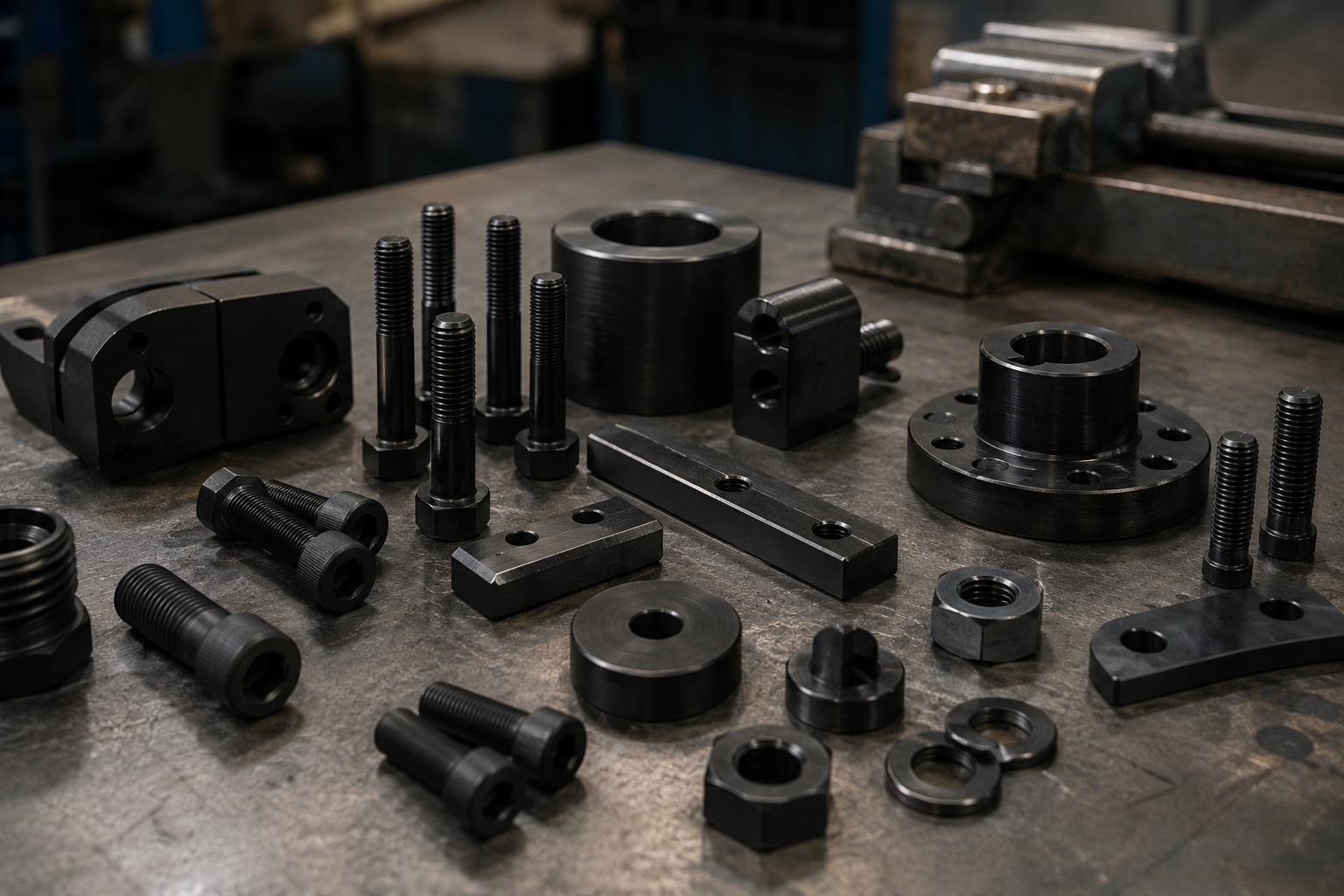
Black Oxide Coating Explained in 60 Seconds
Black oxide coating is a chemical conversion finish that turns the surface of steel or iron into a thin black oxide layer, usually magnetite. It improves appearance, reduces glare, adds light corrosion resistance, and causes almost no dimensional buildup, making it useful for tools, fasteners, fixtures, and precision metal parts.
Black oxide coating is one of those finishes that looks simple from the outside. A steel part goes in, comes out black, and feels cleaner, darker, and more finished.
But in actual shop use, black oxide is not just a cosmetic black finish. It is a thin chemical conversion coating that changes the surface of the metal instead of building a thick layer on top of it. That small difference matters a lot when you are dealing with threads, dowel holes, close-fitting parts, tooling, machine components, or fasteners where paint or plating buildup can create problems.
It also has limits. Black oxide is not a miracle rust-proof coating. Without oil, wax, or another sealant, its corrosion protection is fairly mild. In a dry indoor shop, it can work well. In a wet outdoor environment, it can disappoint quickly.
That is where many people misunderstand it.
What Is Black Oxide Coating?
Black oxide coating is a chemical conversion finish used mainly on ferrous metals such as carbon steel, alloy steel, tool steel, and cast iron. During the process, the surface of the metal reacts with a chemical bath and forms a thin black oxide layer, commonly magnetite, also known as Fe₃O₄.
Unlike paint, powder coating, or heavy plating, black oxide does not create a thick external coating. It changes the outer surface of the part itself.
That is why black oxide is popular for parts where dimensional control matters. Threads, precision pins, tooling components, fixtures, firearm parts, hand tools, gears, and machine hardware can be blackened without adding much measurable thickness.
In most practical applications, black oxide is chosen for four main reasons:
- A clean black appearance
- Reduced light reflection
- Minimal dimensional change
- Mild corrosion protection when sealed properly
The key phrase is when sealed properly. The oxide layer itself is porous. The oil, wax, or sealant that follows the blackening process is what gives the finish much of its real-world corrosion resistance.
How Black Oxide Coating Works
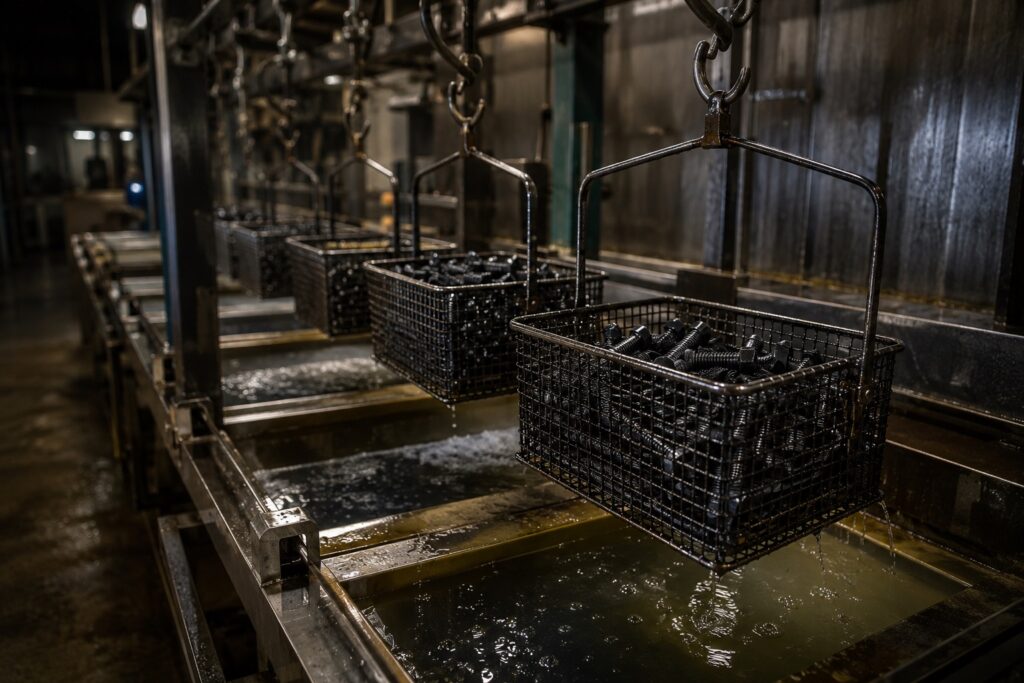
Black oxide works by chemically converting the surface of the metal into a black oxide layer. On steel and iron, the desired layer is usually magnetite. This is different from red rust, which is a more destructive iron oxide.
A typical hot black oxide process follows this general workflow:
- The part is cleaned to remove oil, dirt, coolant, and shop residue.
- The part is rinsed.
- Rust, scale, or oxide may be removed with acid pickling if needed.
- The part is rinsed again.
- The part is placed into a heated black oxide chemical bath.
- The surface reacts and turns black.
- The part is rinsed.
- The part is sealed with oil, wax, or another protective treatment.
The process sounds simple, but the final result depends heavily on preparation. A polished part, a bead-blasted part, and a rough machined part can all come out black, but they will not look the same. Black oxide does not hide surface defects very well. It follows the surface underneath.
If the part has scratches, tool marks, grinding burns, rust pits, or uneven scale, the black finish will usually make those problems more visible, not less.
Types of Black Oxide Coating
There are three common types of black oxide processes: hot, mid-temperature, and cold. They may look similar to someone outside the shop, but they are not equal in durability or chemistry.
Hot Black Oxide
Hot black oxide is the traditional industrial process for steel and iron parts. It uses a heated alkaline salt bath, often around 135–145°C depending on the chemistry and process control.
This method creates a true conversion coating on the surface of the steel. It is usually the best option when you want a durable, consistent black finish on production parts.
Hot black oxide is commonly used for:
- Fasteners
- Tooling
- Machine components
- Firearm parts
- Gears
- Fixtures
- Hand tools
- Precision steel parts
The main advantage is consistency. When the cleaning, bath chemistry, time, temperature, and sealing are controlled properly, hot black oxide gives a uniform black finish with minimal buildup.
The downside is that it requires proper chemical handling, temperature control, ventilation, and process discipline. This is not something most small hobby shops should casually attempt without the right setup.
Mid-Temperature Black Oxide
Mid-temperature black oxide operates at a lower temperature than hot black oxide, often below the boiling point of water. It is used to reduce energy use, fumes, and some safety risks associated with hotter caustic baths.
In many production environments, mid-temperature systems can produce a finish that is close to hot black oxide for certain applications. However, results depend strongly on the specific chemistry and process control.
It is often chosen when a shop wants a balance between finish quality, safety, and operating cost.
Cold Black Oxide
Cold black oxide is different. In many cases, it is not a true oxide conversion process in the same sense as hot black oxide. It often deposits a dark surface layer, commonly involving copper selenide chemistry, rather than converting the steel surface into magnetite.
Cold black oxide can be useful for touch-up work, small batches, cosmetic blackening, or situations where hot processing is not practical.
But it is usually softer, less durable, and more dependent on the final sealant.
A common mistake is assuming cold black oxide gives the same performance as hot black oxide because both look black at first. In real use, cold black oxide usually shows its weakness faster through rubbing, handling wear, and uneven corrosion resistance.
What Metals Can Be Black Oxide Coated?
Black oxide is most commonly used on steel and iron, but similar blackening processes exist for other metals.
| Material | Black Oxide Suitability | Practical Notes |
|---|---|---|
| Carbon steel | Excellent | Most common and predictable material |
| Alloy steel | Excellent | Good for tools, machine parts, and fasteners |
| Cast iron | Good | Surface porosity can affect uniformity |
| Stainless steel | Good with correct process | Requires chemistry suited to stainless grades |
| Copper | Possible | Uses different blackening chemistry |
| Zinc | Possible | Usually more cosmetic and process-specific |
| Aluminum | Generally not ideal | Aluminum is usually better suited to anodizing |
For steel parts, black oxide is a very normal finish. For aluminum, it is usually the wrong conversation. If someone wants a durable black finish on aluminum, black anodizing is generally the better route. In fact, many machinists are surprised to learn that anodizing and black oxide are completely different processes, which is one reason questions like can you anodize stainless steel often create confusion when discussing metal finishing methods.
Benefits of Black Oxide Coating
1. Very Low Dimensional Change
This is one of black oxide’s strongest advantages.
Paint, powder coating, and some plating processes can add enough thickness to interfere with threads, bores, slots, pins, or tight assemblies. Black oxide adds very little measurable buildup.
That makes it useful for:
- Threaded fasteners
- Precision-ground parts
- Machine tool components
- Close-fitting assemblies
- Gauge parts
- Fixturing hardware
If a part already fits correctly and only needs a dark finish with light protection, black oxide can be a good choice.
2. Clean Black Appearance
Black oxide gives steel a uniform black or dark satin appearance. The final look depends on the base metal finish and the sealant used.
Oil usually gives a deeper, slightly glossier finish. Wax can look more subdued. A polished part may look dark and smooth, while a blasted part may look matte.
This is why black oxide is common on tools and hardware. It looks professional without creating the thick coated appearance of paint.
3. Reduced Glare
Black oxide reduces light reflection, which is useful on tools, optical equipment, firearm components, surgical instruments, camera hardware, fixtures, and machine parts.
In a shop setting, glare reduction can be more useful than people expect. Bright bare steel on a fixture or tool holder can reflect light directly into the operator’s eyes, especially near inspection stations or machine lights.
4. Mild Corrosion Resistance
Black oxide improves corrosion resistance, but only to a limited degree.
The oxide layer itself is thin and porous. The real protection comes from the oil, wax, or sealant applied after blackening. If the sealant dries out, washes away, or burns off, corrosion resistance drops quickly.
Understanding how different metals react to oxidation is important because not all materials corrode in the same way. Some metals form protective oxide layers while others rust aggressively in humid environments. If you’re comparing different material families, it’s worth understanding whether nonferrous metals rust and how their corrosion behavior differs from steel.
This is why black oxide performs best in dry indoor environments with occasional handling and light oil maintenance.
It is not the best finish for:
- Marine exposure
- Outdoor brackets
- Road salt
- Wet storage
- Acidic environments
- High-humidity abuse
- Parts that are constantly washed or degreased
For those conditions, zinc plating, nickel plating, phosphate coating with oil, powder coating, paint, stainless steel, or other protective systems may be better.
5. Better Lubricity with Oil
Black oxide with oil can improve lubricity slightly. This can help on sliding surfaces, fasteners, tooling, and break-in surfaces.
It is not a replacement for proper lubrication, but it can reduce dry metal-to-metal harshness compared with bare steel.
On fasteners, the finish can also affect torque behavior. That matters in controlled assemblies. A black oxide fastener with oil will not behave exactly like a dry zinc-plated fastener or a bare steel bolt.
6. No Peeling Like Paint
Because black oxide is a conversion layer, it does not peel like paint or powder coating. If the part wears, the blackened surface can gradually polish, fade, or expose base metal, but it usually does not chip off in sheets.
That is useful on tools, handles, sockets, clamps, and moving components.
Limitations of Black Oxide Coating
Black oxide is useful, but it is often oversold.
1. It Is Not Heavy Corrosion Protection
Black oxide is not a substitute for galvanizing, zinc plating, powder coating, epoxy paint, or stainless steel in harsh environments.
If the main goal is long-term rust prevention outdoors, black oxide is usually not the strongest choice.
A black oxide part can rust if:
- It is left wet
- The oil film is removed
- It is handled with sweaty hands and stored
- It is exposed to salt
- It is cleaned with aggressive solvents
- The surface was poorly prepared before coating
In many shops, black oxide fasteners look great when new but start showing rust after poor storage. That does not always mean the black oxide process failed. Sometimes the finish was simply used in the wrong environment.
2. Surface Prep Matters a Lot
Black oxide does not level the surface. It does not fill pits, scratches, gouges, machining marks, or grinding defects.
If the surface is ugly before coating, it will usually still be ugly after coating — just black.
For a clean finish, parts should be properly deburred, cleaned, and finished before blackening.
A common production issue is inconsistent color from mixed surface conditions. One area may be machined, another blasted, another polished, and another heat-scaled. They can all react differently.
3. Cold Black Oxide Wears Faster
Cold black oxide can be convenient, but it should not be confused with industrial hot black oxide.
It is useful for touch-up, repair, and low-wear cosmetic applications. It is not the best choice for parts that will be handled constantly, rubbed, assembled repeatedly, or exposed to moisture.
4. Sealant Can Change the Final Look
Oil, wax, lacquer, and dry-to-touch sealers all change how the part looks and performs.
Oil may look rich and dark but can feel wet or collect dust. Wax can feel cleaner but may provide different corrosion behavior. A dry sealant may be better for packaged parts, but not always for maximum rust prevention.
This is one of those practical details that matters more in production than in a simple definition.
5. High Heat Can Reduce Protection
If a black oxide part is exposed to heat, the oil or wax sealant can break down. Once that happens, the finish loses much of its corrosion resistance.
For high-temperature parts, black oxide may still provide appearance and glare reduction, but it should not be relied on as a strong protective coating unless the environment is controlled.
Black Oxide vs Other Metal Finishes
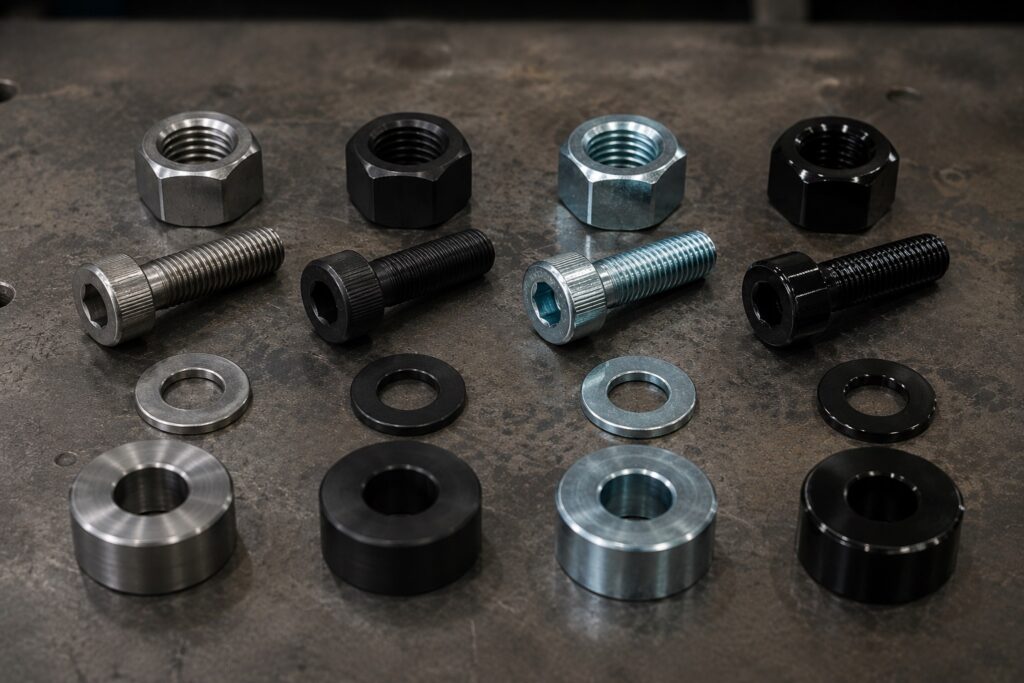
| Finish | Best For | Main Advantage | Main Limitation |
| Black oxide | Precision steel parts, tools, fasteners | Minimal dimensional change | Mild corrosion resistance |
| Zinc plating | Fasteners, brackets, general rust protection | Better corrosion protection | Adds more thickness than black oxide |
| Powder coating | Large parts, frames, covers | Durable barrier coating | Too thick for close tolerances |
| Paint | General protection and color | Cheap and flexible | Chips, scratches, surface prep sensitive |
| Phosphate coating | Firearms, tools, oiled steel parts | Good oil retention | Usually needs oil for protection |
| Black anodizing | Aluminum parts | Durable black finish on aluminum | Not for steel |
| Nickel plating | Wear and corrosion resistance | Hard, bright, protective | More expensive and dimensional buildup |
Surface finish selection becomes even more important when fabricated parts have already been exposed to thermal cutting processes. Edge condition, oxidation, and heat affected zones can all influence how a finishing process performs.
Black oxide is best when dimensional accuracy and appearance matter more than maximum corrosion protection.
If the part needs to survive weather, chemical washdown, or salt exposure, choose another finish.
Common Applications of Black Oxide Coating
Black oxide is commonly used on:
- Socket head cap screws
- Allen keys
- Drill bits
- Reamers
- Taps
- Tool holders
- Measuring tools
- Firearm parts
- Machine fixtures
- Gears
- Sprockets
- Shafts
- Bearings
- Industrial hardware
- Automotive components
- Aerospace parts
- Surgical instruments
- Optical equipment parts
In many cases, the reason is not only appearance. It is the combination of black color, low glare, light protection, and tight dimensional control.
A black oxide socket head screw still fits the same counterbore. A painted screw may not.
That small difference matters in assemblies.
Design Considerations Before Specifying Black Oxide
If you are designing a part and thinking about black oxide, consider these points before sending it out for finishing.
1. Is the Part Steel or Iron?
Black oxide is most predictable on ferrous metals. If the part is aluminum, black anodizing is usually the better option.
For stainless steel, make sure the finishing supplier can process the specific stainless grade correctly.
2. Does the Part Need Real Rust Protection?
If the part will be indoors, lightly oiled, and handled normally, black oxide may be fine.
If it will live outdoors, near water, around road salt, or in a washdown environment, black oxide is probably too weak by itself.
3. Are There Tight Tolerances?
This is where black oxide performs well.
For threads, pins, bores, and precision surfaces, black oxide is often safer than thicker finishes. Still, critical surfaces should be reviewed with the finisher, especially if post-treatment oil or wax could affect assembly.
4. Will the Part Be Handled Often?
Frequent handling can remove oil and expose the finish to sweat. Human hands are rough on black oxide over time. Tools and fasteners may need occasional oiling if appearance and rust resistance matter.
5. Is the Surface Finish Consistent?
If one side of the part is polished and another side is rough milled, the final black appearance may not be perfectly uniform.
Black oxide follows the surface. It does not hide poor prep.
Common Black Oxide Problems and Causes
| Problem | Likely Cause | Practical Fix |
| Uneven black color | Poor cleaning, mixed surface finishes, scale | Improve cleaning and surface prep |
| Rust after coating | Weak or missing sealant, wet storage | Use better oil/wax and dry storage |
| Brown discoloration | Oil oxidation, heat, contamination | Review sealant and operating temperature |
| Finish rubs off easily | Cold black oxide or poor adhesion | Use hot black oxide for durable parts |
| Streaks or blotches | Inadequate rinsing or trapped chemicals | Improve rinse control |
| Poor finish in holes | Air pockets, poor solution flow | Improve racking and agitation |
| Parts feel greasy | Heavy oil sealant | Use dry-to-touch sealant if needed |
| Threads feel different | Oil changes friction | Account for torque changes |
One common shop mistake is treating black oxide as the final step only. In reality, most finish failures start earlier: poor deburring, poor cleaning, mixed alloys, leftover coolant, trapped acid, or bad storage after coating.
Does Black Oxide Prevent Rust?
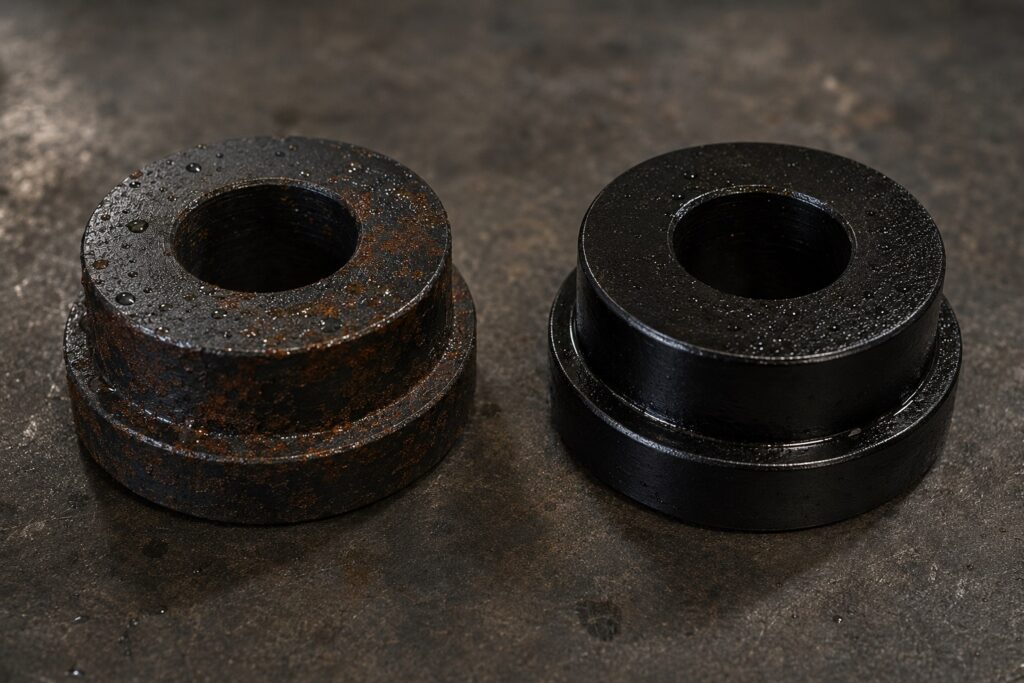
Black oxide helps reduce rust, but it does not fully prevent it.
A sealed black oxide finish can provide mild corrosion resistance in indoor environments. But if the sealant is removed or the part is exposed to moisture and salt, rust can still form.
Think of black oxide as a controlled black surface with light protection, not as a heavy-duty anti-rust system.
For stronger rust protection, consider:
- Zinc plating
- Nickel plating
- Powder coating
- Paint
- Stainless steel
- Phosphate plus oil
- Galvanizing
- Protective oils or corrosion inhibitors
Black oxide is often the right finish for a machine screw inside a tool cabinet. It is usually the wrong finish for a bracket bolted under a truck in winter.
Hot Black Oxide vs Cold Black Oxide
| Feature | Hot Black Oxide | Cold Black Oxide |
| Process type | True conversion on steel | Surface deposit or cosmetic blackening |
| Durability | Better | Lower |
| Appearance | More uniform in production | Can vary more |
| Best use | Production parts, tools, fasteners | Touch-up, small cosmetic work |
| Corrosion resistance | Better when sealed | Limited when sealed |
| Equipment required | Industrial chemical process | Easier small-scale application |
| Wear resistance | Better | Weaker |
Cold black oxide has its place, but it should not be specified when the part needs the performance of hot black oxide.
Is Black Oxide Good for Fasteners?
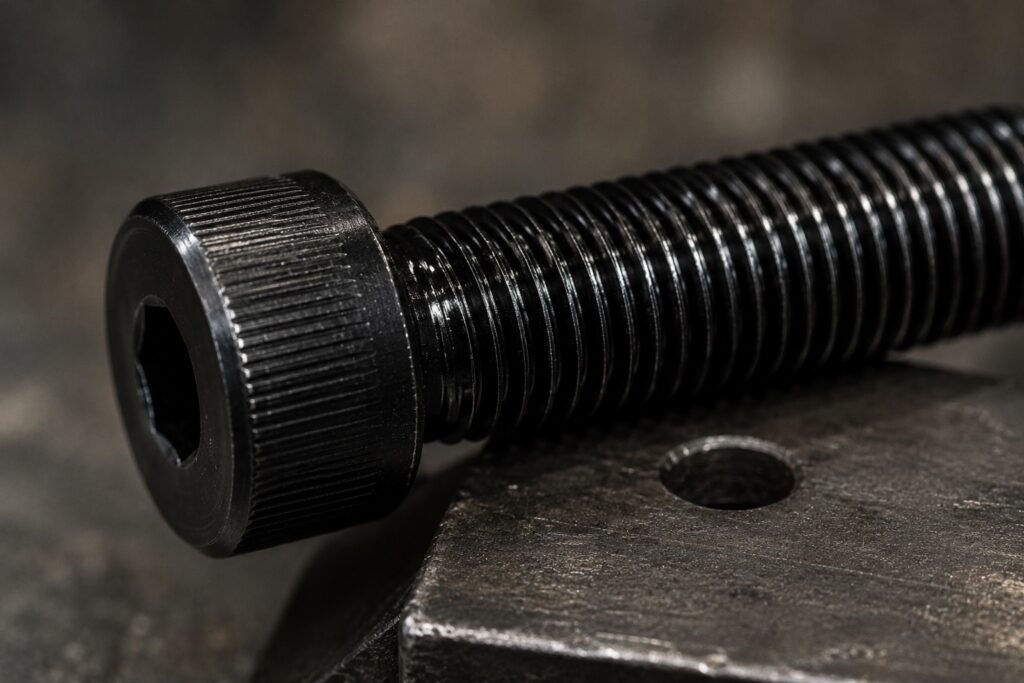
Yes, black oxide is widely used for fasteners, especially socket head cap screws and machine screws.
The main advantages are:
- Clean black appearance
- Minimal thread buildup
- Reduced glare
- Mild corrosion protection with oil
- Good fit in precision assemblies
But black oxide fasteners are not ideal for wet or outdoor environments unless additional protection is used.
Also, the oil on black oxide fasteners can affect torque-tension behavior. In critical assemblies, do not assume a black oxide bolt tightens the same way as zinc-plated, plain, or dry-coated hardware.
Is Black Oxide Good for Tools?
Black oxide works well on many tools because it reduces glare, improves appearance, and adds mild protection without changing tool geometry much.
Black oxide works well on many tools because it reduces glare, improves appearance, and adds mild protection without changing tool geometry much. This is particularly useful for high-carbon hand tools where preserving dimensional accuracy is more important than applying a thick coating, including tools made from the steels discussed in this guide to file steel.
It is common on:
- Drill bits
- Taps
- Reamers
- Wrenches
- Sockets
- Hex keys
- Cutting tools
- Hand tools
On cutting tools, black oxide is not the same as a high-performance coating like TiN, TiAlN, AlTiN, or DLC. It may help with appearance, lubricity, and chip flow in some cases, but it should not be treated as a modern wear-resistant cutting coating.
That distinction matters. A black oxide drill bit is not automatically a premium high-speed production drill.
Professional Tips for Better Black Oxide Results
- Deburr before coating. Burrs look worse after blackening.
- Keep surface finishes consistent if appearance matters.
- Do not expect black oxide to hide scratches or grinding marks.
- Use hot black oxide for real production durability.
- Use cold black oxide mainly for touch-up or cosmetic work.
- Choose oil sealant for richer appearance and better short-term corrosion protection.
- Choose wax or dry sealant when oily handling is a problem.
- Avoid black oxide alone for outdoor or salt-exposed parts.
- Store finished parts dry and clean.
- Re-oil black oxide tools if they start looking dry or gray.
The same principle applies to machined plastics and metals alike—surface preparation almost always determines the quality of the final finish more than the coating itself. Shops that routinely machine plastics already understand this concept from operations like CNC machining acrylic, where surface quality directly affects the final result.
A practical rule: if you would not leave bare oiled steel in that environment, do not expect black oxide to survive there forever either.
When Black Oxide Is the Right Choice
Black oxide is a good choice when the part needs:
- A black appearance
- Low glare
- Tight dimensional control
- Mild indoor corrosion protection
- Better appearance than bare steel
- No thick coating buildup
- Compatibility with threads and precision features
It is especially useful for machined steel parts, tooling, fixtures, and fasteners used in controlled environments.
When Black Oxide Is the Wrong Choice
Black oxide is usually the wrong choice when the part needs:
- Strong outdoor corrosion protection
- Salt spray resistance
- Heavy abrasion resistance
- Long-term wet exposure resistance
- Thick barrier protection
- Bright color options
- A finish that hides surface defects
- Maintenance-free rust prevention
In those cases, another finish will usually perform better.
Common Questions About Black Oxide Coating
What is black oxide coating made of?
On steel, black oxide is usually a magnetite layer, Fe₃O₄, formed by chemical conversion of the surface. The final finish is often sealed with oil, wax, or another protective treatment.
Is black oxide the same as paint?
No. Paint sits on top of the surface as a separate layer. Black oxide chemically converts the surface of the metal, which is why it adds very little thickness.
Does black oxide add thickness?
Only a very small amount. That is one reason it is popular for threads, tools, and precision parts.
Can black oxide rust?
Yes. Black oxide can rust, especially if the sealant is removed or the part is exposed to moisture, salt, or poor storage conditions.
Is black oxide better than zinc plating?
It depends on the goal. Black oxide is better for low dimensional buildup and appearance. Zinc plating is usually better for corrosion protection.
Can aluminum be black oxide coated?
Aluminum is not usually finished with traditional black oxide. Black anodizing is normally the better choice for aluminum parts.
Is black oxide food safe?
Do not assume black oxide is food safe. The chemistry, sealant, and application matter. For food-contact parts, use materials and finishes specifically approved for that use.
Can black oxide be repaired?
Small areas can sometimes be touched up with cold blackening products, but the repair may not match hot black oxide in appearance or durability.
When Is Black Oxide the Right Choice?
Black oxide coating is best understood as a thin, practical, low-buildup black finish for steel and iron parts. It is excellent when you need a clean appearance, reduced glare, and minimal dimensional change.
Its biggest weakness is corrosion protection. Black oxide helps, but it does not turn steel into stainless steel, and it does not replace proper plating or coating in harsh environments.
For indoor tools, fasteners, fixtures, and precision machined parts, black oxide can be a very smart finish. For wet, salty, outdoor, or highly abrasive applications, it should be used carefully — or replaced with a stronger protective system.