
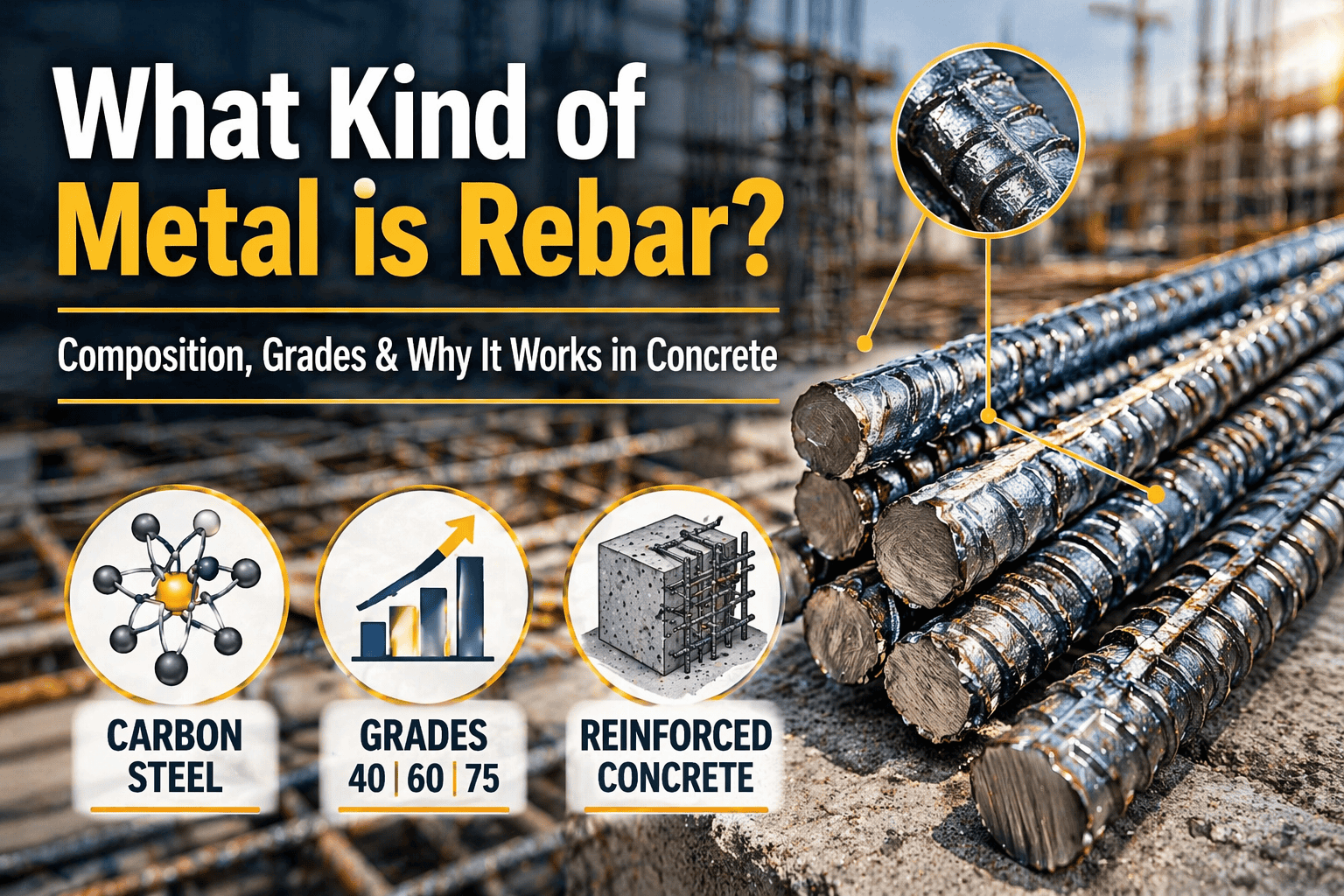
Quick Answer: What Metal Is Rebar Made From?
What kind of metal is rebar?
Rebar is typically made from low-to-medium carbon steel because steel provides the best balance of tensile strength, ductility, thermal expansion compatibility, and long-term durability inside reinforced concrete structures. Some specialty rebar types use stainless steel, epoxy coatings, or fiberglass composites for corrosion resistance.
What Kind of Metal Is Rebar and Why Is It Used?
What kind of metal is rebar, and why is steel used inside concrete?
Rebar — short for reinforcing bar — is usually made from carbon steel designed to reinforce concrete structures against tensile stress and cracking.
Concrete handles compression extremely well, but tension is a completely different story. Even relatively small bending or stretching forces can cause plain concrete to crack. Steel rebar compensates for that weakness by absorbing tensile loads and distributing stress throughout the structure.
That combination creates reinforced concrete — one of the most widely used structural systems in modern construction.
In practical terms:
- Concrete handles compressive loads
- Rebar handles tensile stress
- Together they resist cracking, shifting, and structural fatigue
From real-world construction experience, you’ll usually notice concrete failures first appear around unsupported tensile areas. That’s why proper reinforcement placement matters just as much as the concrete itself.
Why Concrete Needs Rebar (The Core Structural Problem)
Why does concrete need steel reinforcement like rebar?
Concrete is naturally brittle under tension. When slabs, foundations, or beams flex under load, the concrete alone cannot stretch enough to resist cracking.
Rebar changes how the entire structure behaves under stress.
Instead of allowing force to concentrate in one weak area, steel reinforcement spreads loads across the structure and helps prevent sudden fracture.
Without rebar:
- Concrete cracks much earlier
- Structural deflection increases
- Load capacity drops significantly
- Failure becomes less predictable
This becomes even more important in:
- bridge decks
- high-rise buildings
- retaining walls
- seismic zones
- heavy industrial floors
One common mistake in DIY concrete work is assuming thicker concrete automatically eliminates the need for reinforcement. In reality, slab thickness and tensile reinforcement solve different structural problems.
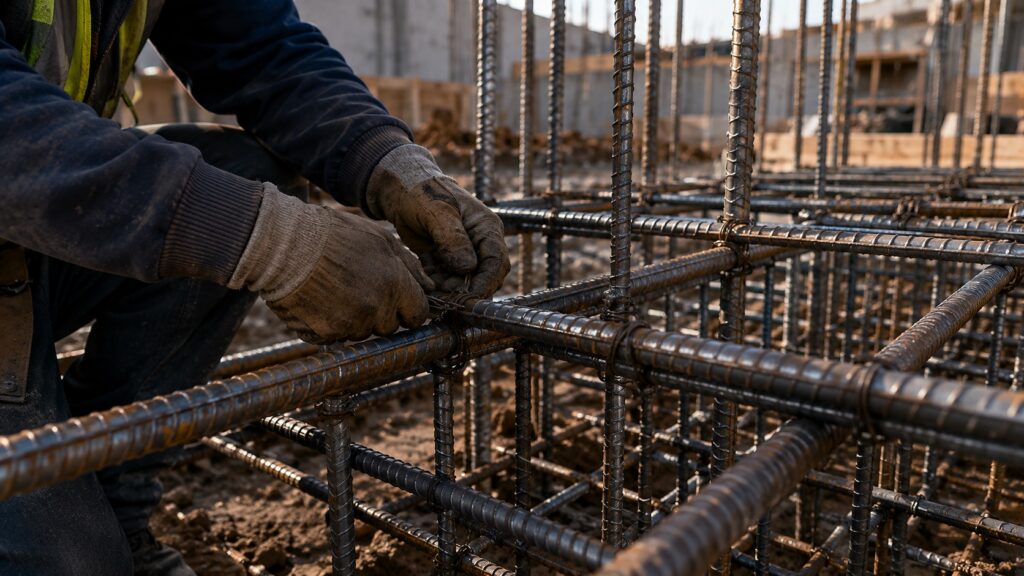
The Science Behind It: Why Steel and Concrete Work Together
Why is carbon steel used in rebar instead of aluminum or pure iron?
One of the biggest reasons is thermal compatibility.
Steel and concrete expand and contract at very similar rates during temperature changes:
α≈12×10−6/∘C
That compatibility helps prevent internal stress buildup as structures heat and cool over time.
If the reinforcement expanded significantly faster than the concrete around it, the structure would gradually crack itself apart through thermal cycling.
This matters in real environments where structures constantly experience:
- seasonal expansion and contraction
- freeze-thaw cycles
- sun exposure
- thermal shock
- moisture movement
Aluminum, for example, expands much more than concrete and also lacks the same structural stiffness. Pure iron, meanwhile, is generally too soft for structural reinforcement applications.
Steel ends up being the best compromise between:
- strength
- ductility
- cost
- weldability
- thermal behavior
- long-term reliability
The same heat-related behavior is also why thermal damage during fabrication matters so much in steel processing. Excessive localized heating can create hardened brittle zones and microstructural changes similar to the issues discussed in this guide on heat affected zones in flame cutting.
In many fabrication environments, you’ll also notice steel tolerates field abuse far better than more brittle alternatives. Rebar often gets dragged, bent, tied, stored outdoors, and partially surface-rusted before installation.
Rebar Composition: What Metal Elements Are Inside?
What metal elements are used in rebar?
Most rebar is manufactured from low-to-medium carbon steel, often using recycled scrap steel melted and refined in electric arc furnaces.
Several alloying elements affect how the rebar behaves mechanically.
| Element | Function |
|---|---|
| Carbon (C) | Increases strength and hardness |
| Manganese (Mn) | Improves toughness and wear resistance |
| Phosphorus (P) | Adds strength but reduces ductility |
| Sulfur (S) | Improves machinability but weakens toughness |
| Silicon (Si) | Improves strength and deoxidation control |
Carbon content is especially important because it directly affects:
- weldability
- brittleness
- flexibility
- cracking resistance
In fabrication shops, higher-carbon steels usually reveal themselves during welding or bending operations. They tend to feel less forgiving once heat enters the equation.
This is also why some reinforcing bars are specifically designed for welding applications while others are not.
These same metallurgy principles also appear in many workshop heat treatment operations. Improper thermal control can dramatically change steel behavior, especially during softening or stress-relief processes like those covered in this guide on how to anneal steel properly.
Carbon Content: Strength vs Flexibility Trade-Off
How does carbon content affect rebar performance?
Carbon is one of the biggest factors controlling rebar behavior.
Lower carbon steel tends to be:
- more ductile
- easier to bend
- better for seismic performance
- safer for welding
Higher carbon steel typically offers:
- higher strength
- better wear resistance
- reduced flexibility
- increased cracking risk
That trade-off becomes extremely important during earthquakes or dynamic loading events.
Structures in seismic regions rely heavily on ductility. A structure that bends slightly without failing is usually far safer than one that remains rigid until catastrophic fracture occurs.
Modern TMT (Thermo-Mechanically Treated) rebar attempts to balance both characteristics by creating:
- a harder outer shell
- a more ductile inner core
Some machinists still prefer simpler carbon steel grades for predictability during cutting and bending, although regional standards vary considerably.
Rebar Grades Explained (Yield Strength Guide)
What do rebar grades actually mean?
Rebar grades primarily indicate yield strength — the amount of stress the steel can handle before permanently deforming.
| Grade | Yield Strength |
|---|---|
| Grade 40 | 40,000 psi |
| Grade 60 | 60,000 psi |
| Grade 75 | 75,000 psi |
Grade 60 is the most commonly used structural rebar in North America because it balances:
- strength
- availability
- cost
- ductility
- workability
Higher-strength grades can reduce material usage, but they sometimes become less forgiving during bending or field fabrication.
From practical fabrication experience, stronger rebar is not automatically easier to work with. Some higher-grade bars spring back more aggressively during bending operations and may require tighter process control.
Rebar Standards: ASTM A615 vs A706
What is the difference between ASTM A615 and ASTM A706 rebar?
These standards mainly separate general-purpose reinforcement from weldable structural reinforcement.
ASTM A615
Standard carbon steel rebar commonly used for:
- foundations
- slabs
- sidewalks
- general structural reinforcement
ASTM A706
Low-alloy rebar specifically designed for:
- improved weldability
- seismic applications
- structural fabrication
The key difference is controlled chemistry.
A706 limits carbon equivalent values to reduce heat-related cracking during welding.
One common field mistake is welding unknown rebar grades without checking specifications first. High-carbon reinforcement can develop heat affected zone cracking surprisingly fast if preheat and filler selection are ignored.
Types of Rebar and Their Materials
What types of rebar materials are used today?
| Type | Material | Corrosion Resistance | Typical Use |
|---|---|---|---|
| Carbon Steel Rebar | Standard carbon steel | Low | General construction |
| Stainless Steel Rebar | Chromium alloy steel | Very high | Marine structures |
| Galvanized Rebar | Zinc-coated steel | Medium-high | Outdoor exposure |
| Epoxy-Coated Rebar | Polymer-coated steel | Medium | Roadway infrastructure |
| GFRP Rebar | Glass fiber composite | Extremely high | Corrosive environments |
Despite newer alternatives, carbon steel still dominates because it combines:
- structural toughness
- affordability
- availability
- energy absorption
- ductility
Fiberglass rebar eliminates corrosion problems, but many engineers still hesitate to use it in high-impact structural applications because it lacks the same yielding behavior as steel.
Material selection becomes even more important once corrosion resistance, hardness, and long-term structural behavior start influencing design requirements. Many of the same alloy trade-offs also appear when comparing different types of stainless steel used in industrial environments.
Why Rebar Has Ribs Instead of a Smooth Surface
Why does rebar have raised ribs?
Those ribs are critical for bond strength.
Smooth steel bars can slip inside concrete under heavy load. Ribbed rebar creates mechanical interlocking that dramatically improves anchorage and load transfer.
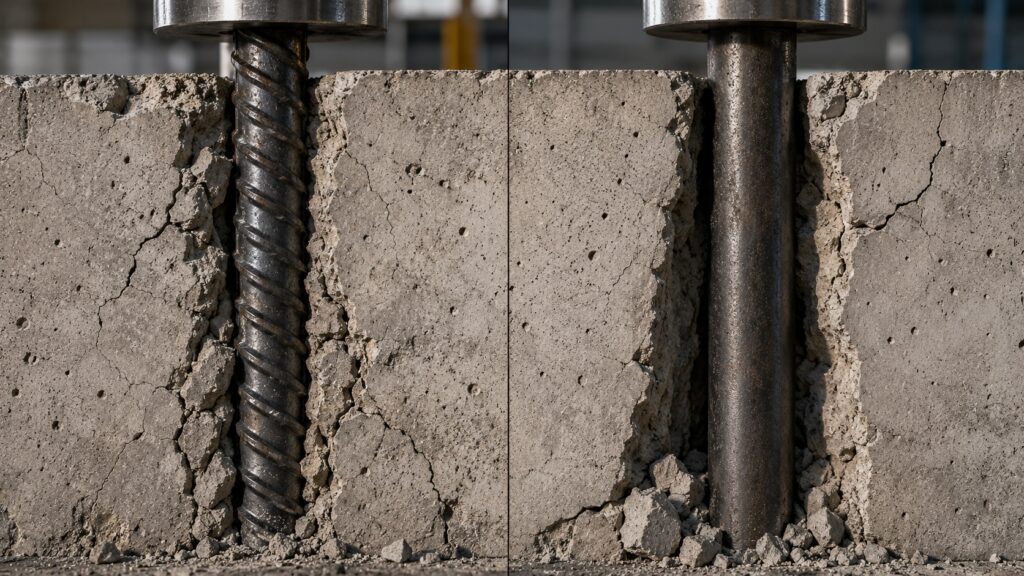
The ribs help:
- prevent slippage
- improve concrete bonding
- distribute stress
- increase pullout resistance
Without deformation ribs, reinforced concrete would lose much of its structural reliability.
You’ll usually notice bond failure first near stress concentration areas or poorly consolidated concrete zones.
Does Rebar Rust in Concrete?
Does rebar rust inside concrete?
Yes — but not all rust is equally dangerous.
Concrete normally protects steel through its highly alkaline environment, which slows corrosion significantly. Problems start when moisture, chlorides, or cracking compromise that protection layer.
Light surface oxidation is often acceptable.
In fact, many fabrication and construction crews consider tight surface rust relatively harmless because it can slightly improve mechanical bonding.
Dangerous corrosion usually involves:
- deep scaling
- flaking rust
- section loss
- pitting
- expanding corrosion beneath concrete
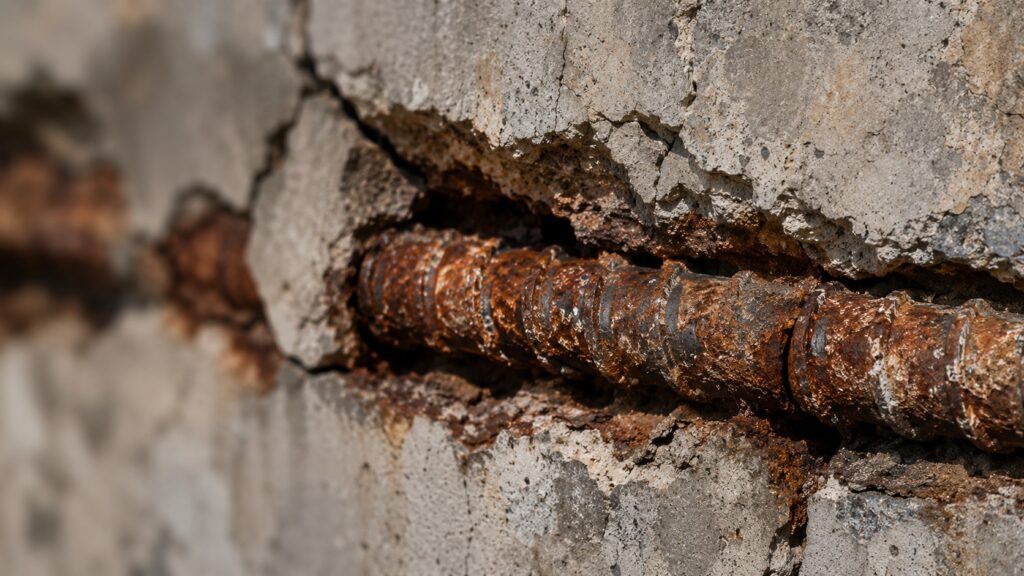
Once corrosion expands enough to crack surrounding concrete, spalling often follows.
Coastal structures, bridge decks, and salted roadway environments usually experience the fastest deterioration because chlorides aggressively attack reinforcing steel.
Corrosion behavior also varies significantly depending on the alloy composition involved. While carbon steel reinforcement can corrode aggressively in chloride-rich environments, many nonferrous materials behave very differently under moisture exposure. That difference is explained further in this article about whether nonferrous metals rust.
Can You Weld Rebar Safely?
Can rebar be welded safely?
Yes — but only when the material grade supports it.
A706 rebar is commonly selected for welding because its chemistry is controlled specifically to reduce cracking risk.
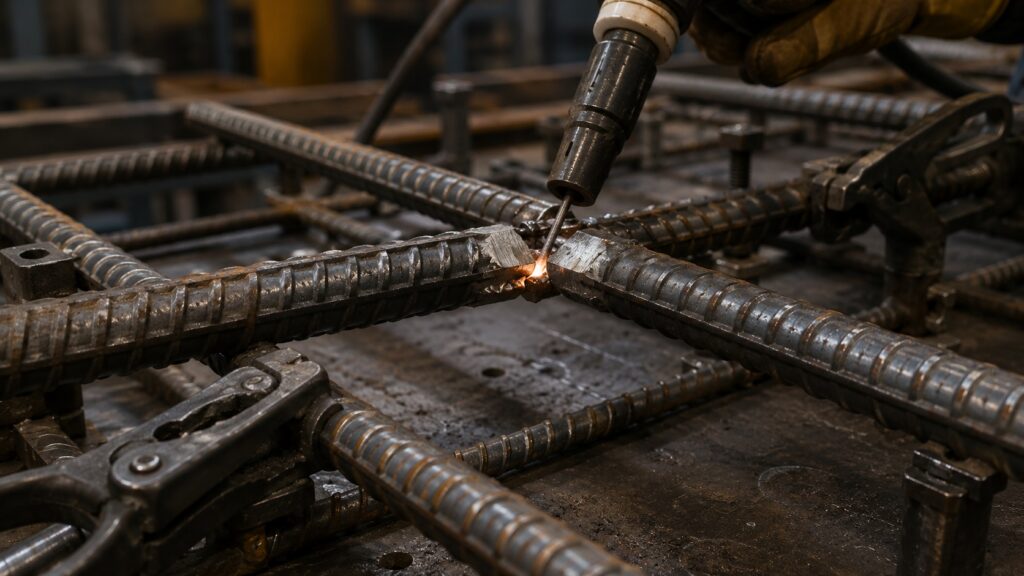
Welding unknown rebar grades can become risky because higher carbon content increases susceptibility to:
- brittle cracking
- hydrogen embrittlement
- heat affected zone failures
- reduced ductility
In many fabrication shops, torch-cut rebar ends also create additional oxidation and localized hardening that complicate welding later.
A frequent issue is excessive heat input during field welding. Operators sometimes assume rebar behaves like ordinary mild steel plate, but reinforcement bars can respond very differently depending on chemistry and manufacturing process.
Many operators also underestimate how much poor setup technique affects weld quality on reinforcing steel. Excessive contamination, unstable arc length, or improper heat input often create unnecessary defects and spatter buildup during field welding. Some of the same control methods explained in this guide on reducing welding spatter also apply to structural steel fabrication work.
Real-World Applications of Rebar
Where is rebar commonly used?
Structural Applications
- foundations
- bridge decks
- retaining walls
- columns
- parking structures
- high-rise buildings
Infrastructure
- highways
- tunnels
- water treatment facilities
- marine construction
Industrial & Fabrication Use
Outside traditional concrete work, rebar is also used for:
- welding fixtures
- shop fabrication
- garden structures
- temporary supports
- furniture frames
Although rebar is inexpensive and widely available, it is not always ideal for precision fabrication because dimensional tolerances and surface consistency vary significantly between mills.
In fabrication shops, reinforcing steel is also frequently cut, bent, and modified using abrasive saws, cutoff wheels, torches, or hydraulic tools depending on jobsite conditions. For smaller projects and field work, these methods overlap heavily with the techniques covered in this guide on how to cut rebar with simple tools.
Is Rebar Always Steel? (Modern Alternatives)
Is all rebar made from steel?
No. Alternative reinforcement materials are becoming more common in highly corrosive environments.
One major example is GFRP (Glass Fiber Reinforced Polymer) rebar.
Advantages include:
- zero corrosion
- lightweight handling
- electrical non-conductivity
- chemical resistance
However, fiberglass reinforcement behaves differently under stress.
Unlike steel, it does not yield gradually before failure. That lack of ductility still limits adoption in many structural applications where energy absorption and deformation behavior matter.
Some engineers disagree on how aggressively composite reinforcement should replace steel long term, especially in heavy structural systems.
Common Questions About Rebar Steel
Is rebar stainless steel or carbon steel?
Most rebar is carbon steel. Stainless steel rebar exists for marine, bridge, and corrosive environments where long-term corrosion resistance justifies the higher cost.
Why is rebar ribbed instead of smooth?
The ribs create mechanical bonding with concrete, preventing slippage and improving load transfer inside reinforced structures.
Can lightly rusted rebar still be used?
Usually yes. Tight surface rust is often acceptable, but deep flaking corrosion or section loss weakens the bar and may fail inspection requirements.
Why is Grade 60 rebar so common?
Grade 60 provides one of the best balances between strength, ductility, availability, and cost for general construction applications.
Can rebar be flame cut?
Yes, but flame cutting can create localized oxidation and hardened edges that may complicate later welding or bending operations.
Is fiberglass rebar stronger than steel?
Fiberglass rebar resists corrosion extremely well, but steel still offers better ductility and energy absorption in many structural applications.
Why Rebar Steel Still Dominates Modern Construction
Rebar is far more than just steel placed inside concrete.
Its effectiveness comes from the balance between tensile strength, ductility, thermal expansion compatibility, bond performance, and long-term structural reliability.
Modern reinforced concrete works because steel and concrete compensate for each other’s weaknesses remarkably well.
Choose the correct reinforcement, and structures can survive for decades under extreme loading, temperature cycling, moisture exposure, and structural stress.
Choose poorly — or ignore installation quality — and even strong concrete eventually starts failing from the inside out.