
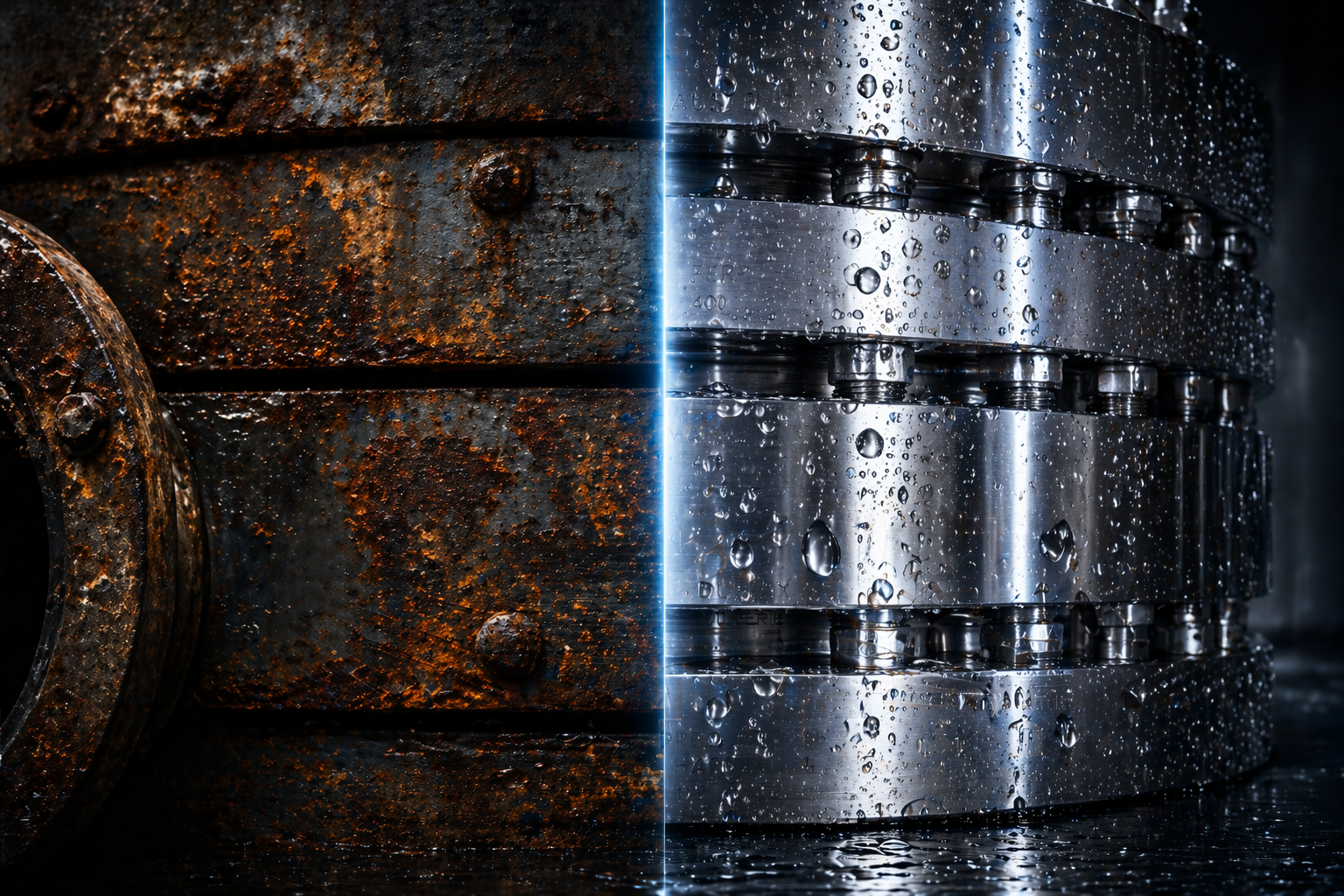
Stainless steel is a corrosion-resistant alloy that contains at least 10.5% chromium, which forms a protective oxide layer on the surface and prevents rust formation under normal conditions.
What You’ll Learn in This Guide
- What makes stainless steel corrosion-resistant
- The 5 main types of stainless steel
- Differences between 304 and 316
- How to choose the right grade
- Common mistakes to avoid
Stainless steel shows up everywhere—from food-processing lines and medical devices to offshore platforms and architectural façades—but it’s rarely chosen by accident. The difference between a component that lasts decades and one that fails prematurely often comes down to selecting the right stainless steel grade for the environment.
What many engineers and fabricators discover the hard way is that “stainless” does not mean “immune to corrosion.” Chlorides, heat, weld conditions, and even surface finish can turn a seemingly safe choice into a maintenance problem—or worse, a structural liability.
Choosing the wrong grade isn’t just a material mistake; it’s a cost multiplier. It leads to:
- premature corrosion and unplanned downtime
- rework or full replacement of components
- safety risks in critical systems
- long-term loss of performance in aggressive environments
Understanding what actually makes steel “stainless” is the foundation for making correct, defensible material decisions.
What Makes Steel Stainless?
The Role of Chromium (Minimum 10.5%)
At its core, stainless steel is still steel—primarily iron—but what sets it apart is the addition of chromium (Cr).
For a steel to be classified as “stainless,” it must contain at least 10.5% chromium by weight. This threshold isn’t arbitrary. Below this level, steel behaves like conventional carbon steel and is prone to rapid oxidation (rust). Above it, something fundamentally different happens.
Chromium changes the surface chemistry of steel. Instead of forming flaky, unstable rust like iron does, chromium enables the formation of a stable, protective oxide layer that adheres tightly to the surface.
Industry Note
The corrosion resistance of stainless steel is widely defined by its chromium content and passive oxide layer formation.
However, real-world performance depends heavily on environmental exposure, fabrication quality, and grade selection—not just chemical composition.
The Passive Layer: The Real Reason Stainless Steel Resists Corrosion
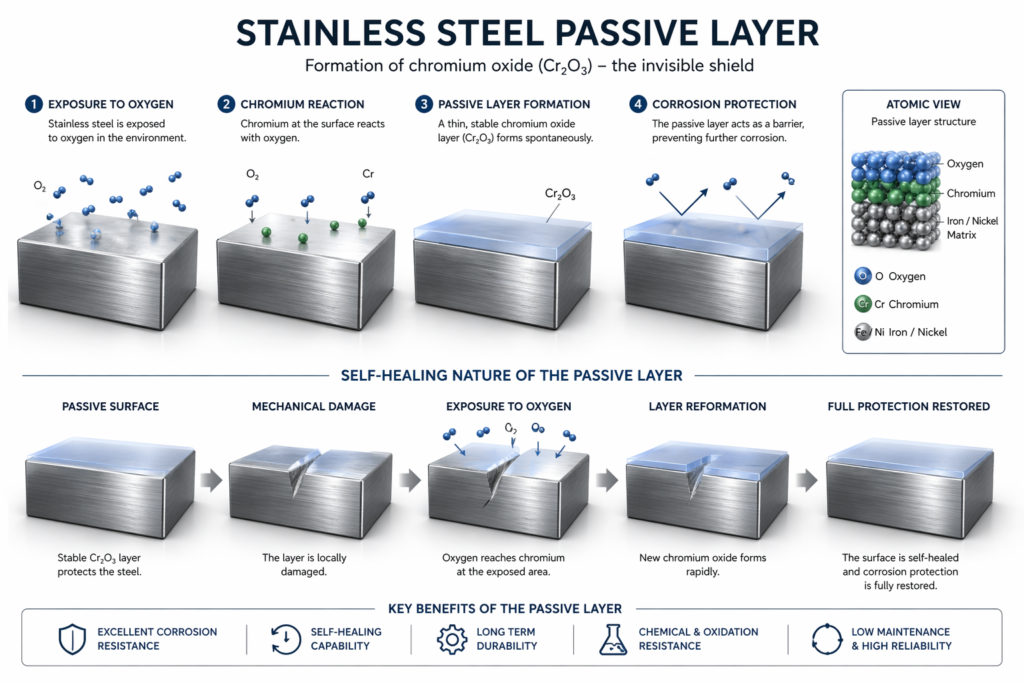
The defining feature of stainless steel is not just chromium content—it’s the passive layer that chromium creates.
This layer is:
- extremely thin (only a few nanometers thick)
- invisible to the naked eye
- chemically stable
- strongly bonded to the surface
When exposed to oxygen, chromium reacts to form chromium oxide (Cr₂O₃). This oxide layer acts as a barrier, preventing oxygen and moisture from reaching the underlying metal.
The critical advantage?
👉 It self-heals.
If the surface is scratched, machined, or worn:
- the exposed chromium reacts again with oxygen
- a new passive layer forms almost instantly
This is why stainless steel can maintain corrosion resistance even after mechanical damage—something regular steel cannot do.
Why Not All Stainless Steel Performs the Same
While 10.5% chromium is the minimum, higher chromium content generally improves corrosion resistance. But chromium alone doesn’t define performance.
Other alloying elements play key roles:
- Nickel (Ni) → improves ductility and corrosion resistance
- Molybdenum (Mo) → enhances resistance to chlorides (critical for marine use)
- Carbon (C) → affects strength and weldability
- Nitrogen (N) → increases strength and pitting resistance
This is why:
- 304 performs well in general environments
- 316 performs better in marine or chloride-rich conditions
- duplex grades outperform both in aggressive industrial settings
👉 Same “stainless steel” label, completely different real-world behavior.
Why Choosing the Wrong Grade Is Expensive
A common mistake in engineering and fabrication is assuming:
“If it’s stainless, it won’t rust.”
In reality:
- 304 can pit and corrode in saltwater
- ferritic grades may fail under cyclic loading
- martensitic grades may lack corrosion resistance in chemical environments
These mismatches lead to:
- pitting corrosion
- crevice corrosion
- stress corrosion cracking
- weld zone failure
And once corrosion starts in stainless steel, it often progresses faster than expected because it’s localized and difficult to detect early.
Key Takeaway
Stainless steel resists corrosion because of a chromium-rich passive oxide layer—not because it “can’t rust.”
The minimum 10.5% chromium content enables this self-healing protective layer, but real-world performance depends heavily on the full alloy composition. Choosing the wrong grade can lead to rapid failure, even in materials labeled “stainless.”
Real-World Insight (From the Shop Floor)
In many real-world projects, 304 stainless steel is chosen to reduce initial cost.
However, in coastal or humid environments, this often leads to early staining and pitting corrosion.
Switching to 316 in the same conditions usually eliminates these issues completely.
👉 Saving money upfront often results in higher costs later.
The 5 Main Types of Stainless Steel Explained
Austenitic Stainless Steel (300 Series)
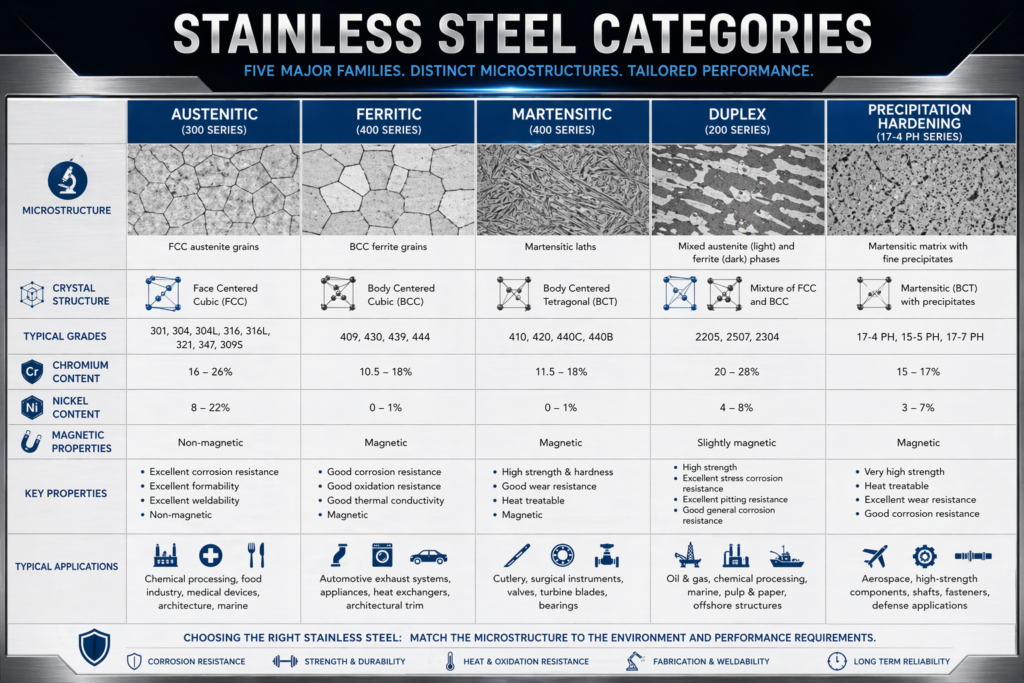
Austenitic stainless steels are the most widely used family, accounting for the majority of stainless applications worldwide. Their structure is face-centered cubic (FCC), which gives them excellent ductility, corrosion resistance, and formability.
Deep Dive: 304 vs 316 Stainless Steel
- 304 Stainless Steel
- Composition: ~18% Chromium, 8% Nickel
- The “default” stainless steel used across industries
- Excellent general corrosion resistance
- Performs well in most indoor and mild outdoor environments
- 316 Stainless Steel
- Composition: ~16–18% Chromium, 10–14% Nickel, 2–3% Molybdenum
- The addition of Molybdenum (Mo) is the key upgrade
- Significantly improves resistance to:
- chloride attack (saltwater, de-icing salts)
- pitting corrosion
- crevice corrosion
👉 This is why 316 is the go-to choice for marine, chemical, and coastal environments.
Key Characteristics
- Non-magnetic (in annealed condition)
- Excellent corrosion resistance
- High ductility and formability
- Cannot be hardened by heat treatment
Machinability & Weldability
- Machinability: ★★☆☆☆ (moderate to difficult due to work hardening)
Austenitic stainless steels tend to work harden quickly, which makes them more difficult to machine. Using proper CNC machining techniques is critical to avoid excessive tool wear and poor surface finish.
- Weldability: ★★★★★ (excellent, especially low-carbon grades like 304L/316L)
While stainless steel is generally easy to weld, improper technique can lead to issues like spatter and poor weld quality. Applying the right welding practices helps maintain both strength and corrosion resistance.
Common Applications
- Food processing equipment
- Chemical tanks and piping
- Marine hardware (316)
- Architectural structures
- Medical equipment
Ferritic Stainless Steel (400 Series)
Ferritic stainless steels have a body-centered cubic (BCC) structure and typically contain low carbon and moderate chromium (10.5–18%).
Focus Grades: 430 and 409
- 430 Stainless Steel
- Good corrosion resistance in mild environments
- Widely used for decorative and indoor applications
- Lower cost due to no nickel content
- 409 Stainless Steel
- Lower corrosion resistance than 430
- Designed for automotive exhaust systems
- Performs well under high-temperature oxidation
Key Characteristics
- Magnetic (important distinction from austenitic)
- Lower cost compared to 300 series
- Moderate corrosion resistance
- Limited toughness compared to austenitic steels
Machinability & Weldability
- Machinability: ★★★★☆ (good)
- Weldability: ★★★☆☆ (moderate, risk of grain growth)
Common Applications
- Automotive exhaust systems (409)
- Kitchen appliances
- Decorative panels
- Heat exchangers
- Indoor architectural trim
Martensitic Stainless Steel
Martensitic stainless steels are designed for high strength and hardness. Unlike austenitic and ferritic types, they can be heat treated to significantly increase mechanical properties.
Focus Grades: 410 and 420
- 410 Stainless Steel
- Basic martensitic grade
- Good strength and moderate corrosion resistance
- Often used where wear resistance matters
- 420 Stainless Steel
- Higher carbon content than 410
- Can achieve very high hardness after heat treatment
- Commonly used in cutting tools and blades
Key Characteristics
- Can be hardened via heat treatment
- Lower corrosion resistance than austenitic grades
- High wear resistance
- Magnetic
Can be hardened via heat treatment, which significantly improves strength and hardness. Different heat treatment processes can change how metals behave under stress and temperature.
Machinability & Weldability
- Machinability: ★★★★☆ (good, especially in annealed condition)
- Weldability: ★★☆☆☆ (limited, preheating often required)
Common Applications
- Knife blades and surgical instruments
- Industrial cutting tools
- Turbine components
- Shafts and fasteners
Duplex Stainless Steel
Duplex stainless steel combines austenitic and ferritic microstructures in roughly equal proportions.
👉 This is why it’s often described as:
“The best of both worlds”
Why Duplex Stands Out
- Higher strength than austenitic steels
- Better resistance to stress corrosion cracking
- Excellent performance in chloride-rich environments
- Lower nickel content than austenitic → cost advantage in some cases
Common Grades
- 2205 Duplex (most widely used)
- 2507 Super Duplex (extreme environments)
Key Characteristics
- Balanced strength + corrosion resistance
- Good fatigue resistance
- Performs well in aggressive industrial conditions
Machinability & Weldability
- Machinability: ★★★☆☆ (moderate, tougher than austenitic)
- Weldability: ★★★★☆ (good with proper control)
Common Applications
- Oil & gas pipelines
- Offshore platforms
- Chemical processing equipment
- Desalination plants
- Pressure vessels
Precipitation-Hardening Stainless Steel
Precipitation-hardening (PH) stainless steels are engineered for very high strength with good corrosion resistance. They achieve this through a controlled heat treatment process that forms strengthening phases within the metal.
Key Grades: 17-4 PH and 15-5 PH
- 17-4 PH (most common)
- Excellent strength-to-weight ratio
- Good corrosion resistance
- Widely used in high-performance industries
- 15-5 PH
- Improved toughness compared to 17-4
- More uniform microstructure
Key Characteristics
- Very high strength after aging treatment
- Good dimensional stability
- Better corrosion resistance than martensitic steels
- Can be precisely controlled via heat treatment
Machinability & Weldability
- Machinability: ★★★★☆ (good in solution-annealed condition)
- Weldability: ★★★☆☆ (moderate, requires process control)
Common Applications
- Aerospace components
- Turbine blades
- High-strength shafts
- Defense and military hardware
- High-performance industrial parts
These five families define how stainless steel behaves in real-world applications. Understanding their differences is what allows engineers and machinists to select the right material—not just a “stainless” one.
304 vs. 316 Stainless Steel: The Definitive Showdown
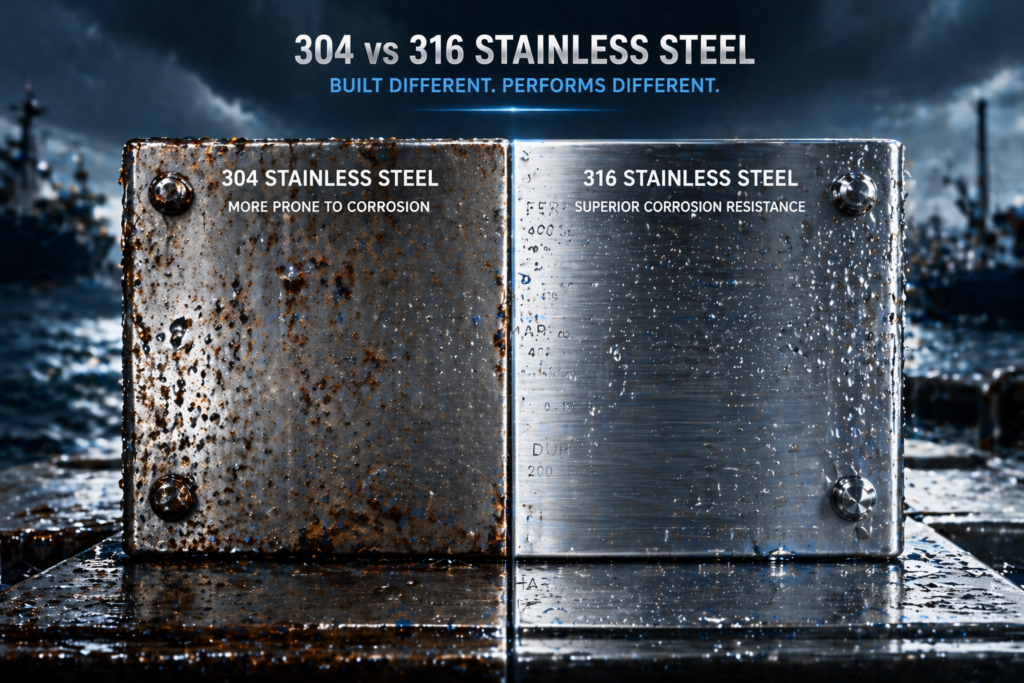
If there’s one comparison that defines real-world stainless steel selection, it’s 304 vs. 316. On paper, they look similar. In practice, choosing the wrong one can mean the difference between decades of performance—or visible corrosion within months.
Composition: The Critical Difference
Both are austenitic stainless steels, but their alloying strategies diverge where it matters most.
- 304 Stainless Steel
- ~18% Chromium, ~8% Nickel
- No molybdenum
- Balanced, general-purpose composition
- 316 Stainless Steel
- ~16–18% Chromium, ~10–14% Nickel
- 2–3% Molybdenum (Mo)
- Engineered for aggressive environments
👉 That molybdenum addition is not a minor tweak. It fundamentally improves resistance to chloride-induced corrosion, especially pitting and crevice attack—the most common failure modes in real-world service.
Corrosion Resistance: Where 316 Wins
In neutral or indoor environments, both 304 and 316 perform well. The gap appears when chlorides, salts, or chemical exposure enter the picture.
- 304
- Performs well in:
- indoor environments
- mild outdoor exposure
- Vulnerable to:
- saltwater
- de-icing salts
- food processing chlorides (in some cases)
- Performs well in:
- 316
- Designed for:
- marine environments
- coastal infrastructure
- chemical processing
- Superior resistance to:
- pitting corrosion
- crevice corrosion
- chloride attack
- Designed for:
👉 If chlorides are present, 304 is a risk. 316 is a safeguard.
Cost vs Performance: Where Most Mistakes Happen
- 304 is cheaper → lower nickel, no molybdenum
- 316 is more expensive → added alloying cost
This leads to a common engineering mistake:
Using 304 in environments where 316 is required.
Short-term savings → long-term failure.
Typical consequences:
- rust staining within months
- localized pitting that spreads rapidly
- costly replacements in installed systems
👉 The real cost difference isn’t material price—it’s lifecycle performance.
Mechanical Properties & Fabrication
From a machining and fabrication perspective, 304 and 316 behave similarly:
- Both:
- excellent formability
- high ductility
- strong work-hardening tendency
- Machinability
- Both are relatively difficult to machine (gummy behavior)
- Require sharp tooling and proper speeds/feeds
- Weldability
- Both are excellent
- Low-carbon variants (304L / 316L) reduce carbide precipitation risk
When Should You Choose Each?
Choose 304 if:
- environment is dry or low-corrosion
- cost sensitivity is high
- application is indoor or controlled
Choose 316 if:
- exposure to salt, chemicals, or moisture is likely
- failure is not acceptable
- long-term durability is critical
👉 In uncertain environments, engineers often default to 316 as a safety margin.
Bottom Line
304 is the standard. 316 is the upgrade.
The difference is not theoretical—it shows up in corrosion performance, maintenance cost, and service life.
Stainless Steel Grades Comparison Table
Below is a practical comparison of the most commonly used stainless steel grades across industries:
| Grade | Corrosion Resistance (1–10) | Magnetic Properties | Cost Factor ($–$$$) | Best For (Application) |
|---|---|---|---|---|
| 304 | 7/10 | Non-magnetic | $$ | General-purpose use, indoor/outdoor structures, food equipment |
| 316 | 9/10 | Non-magnetic | $$$ | Marine, chemical processing, coastal environments |
| 430 | 5/10 | Magnetic | $ | Appliances, decorative panels, low-cost applications |
| 420 | 4/10 | Magnetic | $$ | Knives, tools, wear-resistant components |
| 2205 (Duplex) | 10/10 | Partially magnetic | $$$ | Offshore, oil & gas, high-stress + corrosive environments |
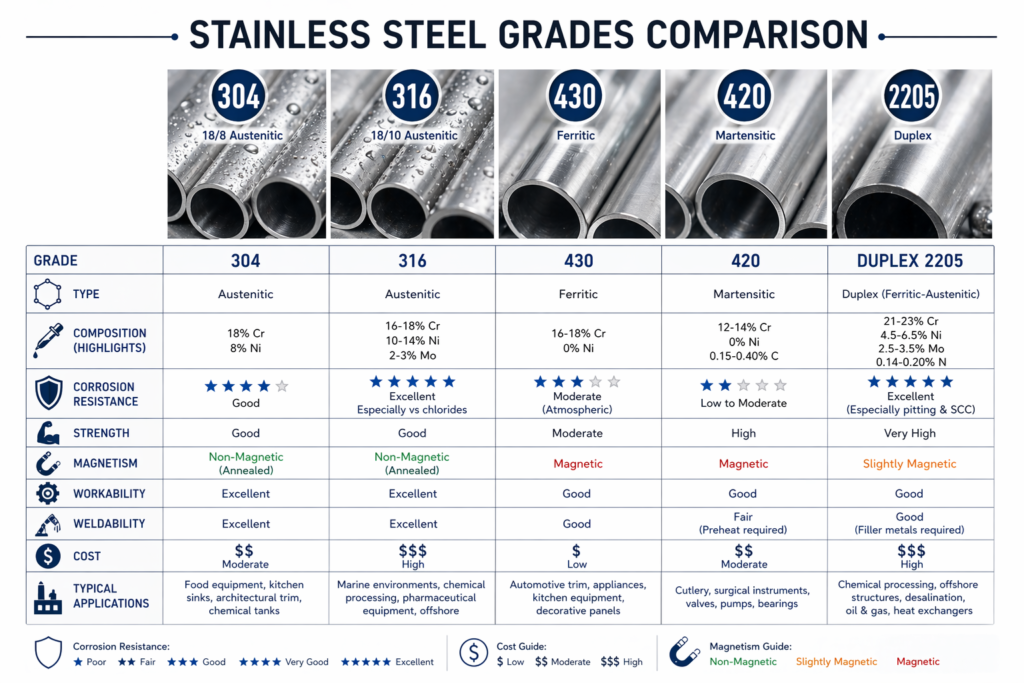
How to Read This Table
- Corrosion Resistance reflects real-world performance, especially in aggressive environments
- Magnetic Properties help distinguish austenitic vs ferritic/martensitic behavior
- Cost Factor is relative (material + alloying elements)
- Best For highlights where each grade actually performs—not just where it’s used
This comparison is where theory meets application. Engineers don’t choose “stainless steel”—they choose a specific grade for a specific environment.
How to Choose the Right Grade for Your Project?
Quick Selection Guide (Fast Decision)
- General indoor / low corrosion → 304
- Coastal / marine / chemicals → 316
- High strength + corrosion → Duplex (2205)
- Blades / wear resistance → 420
- Low-cost decorative use → 430
👉 When in doubt, choose 316 over 304 in humid or chloride environments.
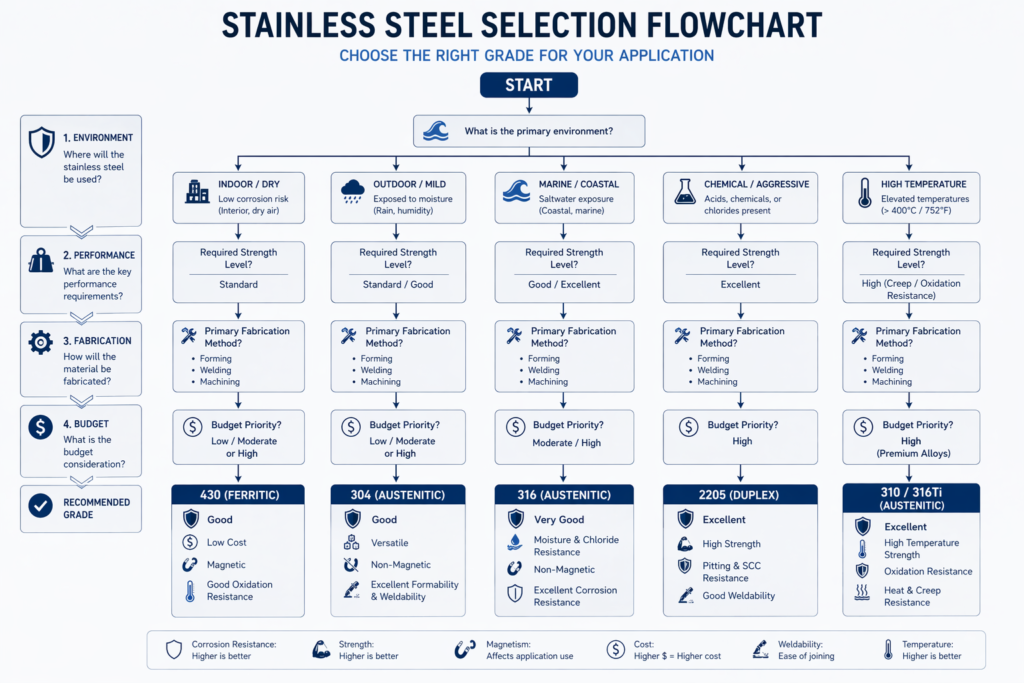
Selecting a stainless steel grade isn’t about picking the “strongest” or the “most corrosion-resistant” option—it’s about matching material behavior to real service conditions. The right choice balances environment, mechanics, fabrication, and budget over the component’s full lifecycle.
1) Environment: The First Filter
Start with where the part will live. This single factor eliminates most wrong choices.
- Dry / indoor → 304 or 430 are usually sufficient
- Outdoor (urban/rural) → 304 works; 316 if moisture and pollutants are higher
- Coastal / marine / de-icing salts → 316 or Duplex (2205)
- Chemical exposure / chlorides → 316 minimum; Duplex or higher alloys for aggressive media
- High temperature / cyclic heat → consider ferritic (e.g., 409) or stabilized austenitic grades (e.g., 321)
What most projects get wrong: they underestimate chlorides (salt, cleaners, process fluids). That’s where 304 fails first.
2) Mechanical Requirements: Strength, Hardness, Fatigue
Not all stainless steels are designed for the same mechanical role.
- High strength / load-bearing → Duplex (2205), PH grades (17-4 PH)
- Hardness / wear / cutting edges → Martensitic (410, 420, 440C)
- Formability / deep drawing / complex shapes → Austenitic (304, 316)
- Fatigue / cyclic loading → Duplex performs well
Don’t confuse corrosion resistance with strength. A highly corrosion-resistant alloy may not meet your load requirements—and vice versa.
3) Fabrication: Machining, Welding, Forming
Your manufacturing route can narrow the field quickly.
- Machining
- Austenitic (304/316): tougher to machine (work-hardening)
- Martensitic / PH: generally easier in the right condition
- Welding
- Austenitic (304L/316L): excellent
- Ferritic: moderate (grain growth risk)
- Martensitic: limited (preheat/post-heat often required)
- Forming
- Austenitic: best ductility
- Ferritic/Martensitic: more limited
If welding is critical, low-carbon “L” grades reduce sensitization and intergranular corrosion risk.
4) Budget: Initial Cost vs Lifecycle Cost
Material price is only part of the story.
- Lower upfront cost → 430, 304
- Higher upfront cost → 316, Duplex, PH
- Lifecycle cost (maintenance, replacement) often favors higher grades
A cheaper grade that corrodes early is almost always more expensive in the long run.
5) Surface Condition & Design Details (Often Overlooked)
- Smooth finishes (lower Ra) resist contamination and corrosion better
- Avoid crevices where moisture can stagnate
- Consider drainage and cleanability in design
- Post-fabrication cleaning/passivation can restore corrosion resistance
Practical Selection Shortcuts
- General use (indoor/outdoor, low chlorides): 304
- Coastal / chemical exposure: 316
- High strength + corrosion: Duplex 2205
- Hardness / blades / wear: 420 (martensitic)
- Low-cost, decorative, mild conditions: 430
FAQ: Stainless Steel Selection
Is 304 or 316 better for outdoor use?
304 stainless steel is suitable for most outdoor environments with low humidity and no salt exposure.
However, 316 stainless steel is the better choice for coastal areas, high humidity conditions, or environments with chlorides, as it offers superior resistance to corrosion, pitting, and staining.
Does all stainless steel stick to a magnet?
No.
Austenitic grades (304, 316) are generally non-magnetic in the annealed state.
Ferritic (430) and martensitic (410, 420) are magnetic.
Cold working can induce slight magnetism even in austenitic steels.
What is the most expensive type of stainless steel?
There isn’t a single “most expensive,” but generally:
Duplex (e.g., 2205, 2507) and high-alloy austenitic grades are costly due to alloying elements.
Precipitation-hardening (17-4 PH) can also be expensive due to processing and performance.
Prices fluctuate with nickel and molybdenum markets.
Why is my stainless steel rusting?
Stainless steel can corrode if its passive layer is compromised or the environment is aggressive.
Common causes:
Exposure to chlorides (salt, cleaners)
Contamination (iron particles from tooling)
Poor surface finish or crevices trapping moisture
Wrong grade selection for the environment
Weld sensitization (improper grade/process)
“Stainless” means corrosion-resistant—not corrosion-proof.
Conclusion: Choose the Grade, Not Just “Stainless Steel”
Stainless steel isn’t a single material—it’s a family of alloys engineered for specific conditions. The right choice depends on how corrosion, strength, fabrication, and cost interact in your application.
- Start with the environment
- Validate mechanical requirements
- Check fabrication constraints
- Balance upfront vs lifecycle cost
Get these right, and your component performs for years. Get them wrong, and problems show up fast—and expensively.
About the Author
This guide was written by a materials and manufacturing specialist with hands-on experience in stainless steel selection, machining, and fabrication.
The insights are based on real-world applications where incorrect material selection leads to corrosion, failure, and costly rework.
Need Help Choosing the Right Grade?
Choosing the wrong stainless steel can lead to costly failures.
If you’re unsure between options like 304, 316, or duplex grades, start by evaluating:
- Exposure to moisture or chlorides
- Mechanical load requirements
- Fabrication method (welding, machining)
Even small differences in environment can completely change the correct material choice.
👉 When in doubt, always prioritize long-term performance over initial cost.